The deployment view
The program as a queueing network.
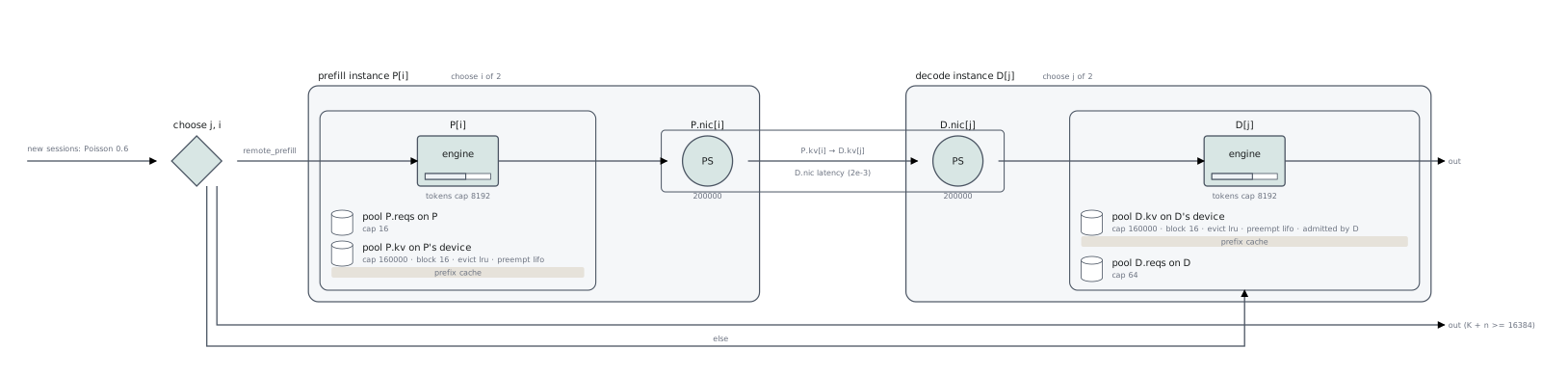
That is examples/pd-disaggregation/llmd_nixl_pull.sq: two prefill and two decode
instances, the KV read over NIXL. Each filled panel is an instance: what the
router's choose picks, a pod with its engine, its NIC and its pools; the
engine's slots and KV blocks are drawn in the engine's frame. The
read crosses from the prefiller's box to the decoder's: it holds the
prefiller's NIC and the decoder's at once, so its two stations are bracketed
as one job, and what it moves (P.kv[i] → D.kv[j]: the prefiller's blocks
stay leased until it ends, the decoder's are allocated before it starts) and
the link's latency are written on it.
Request flow
For a program with a server or gateway, the figure shows one request's
path. Workload tool calls, subsequent turns and session exits are omitted,
but holds surrounding the workload's request remain visible. When there
is no unique request body, or when drawing IR directly, the figure shows
the full session.
| Element | Meaning |
|---|---|
| Station | A stage reached by a run; an array is labelled with its size. Consecutive prefill and decode runs at one engine share a station. |
| Arrow | Request flow between stages, including branches and loop returns. Guards label alternatives; out marks an exit. |
| Decision diamond | A branch or routing decision before the first station. |
| Filled panel | An instance selected by choose, grouping the engine, NIC and pools indexed by exactly its variable. One the session also indexes otherwise (E[j], E[0]) is in no panel; a panel takes in a dashed enclosure only when all of it stands inside. An instance's pool is drawn only inside its panel, so a station outside it does not show that hold; a run between stations the panels would pull apart is drawn outside them. |
| Dashed enclosure | A pool held across several stations. |
| Unfilled frame | Pools held at one station, listed below its glyph. |
| Transfer bracket | A job using both endpoints' NICs; its label names the source and destination KV. |
| Latency label | A delay before a single transfer. A delay leading to several transfers remains a station. |
The diagram simplifies control flow. Consecutive visits to one station do not add an arrow, and guard chains with no intervening station collapse. A guard fixed by earlier constant assignments can omit an arm with no station; parameter-controlled alternatives remain visible. Inspect the program when you need the exact execution path.
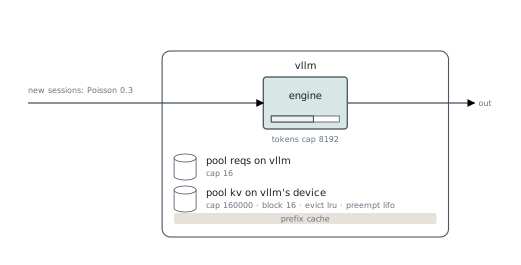
That is examples/multi-turn/vllm.sq. Its request slot (reqs) and its
KV blocks (kv) are held only at vllm, so they are drawn in its frame.
The tool call and the next turn are the workload's, so the figure has
neither: a request arrives at vllm and goes out.
Glyphs
| IR | Glyph |
|---|---|
Fifo(c) |
circle, FIFO, the server count when c ≠ 1 |
Ps(φ) |
circle, PS, with φ beneath |
Delay |
rounded box with a duration-density glyph: decaying for ~exp and ~h2, a hump for ~erlang, flat for ~uniform, a spike for a deterministic duration. Other or long expressions use a row of small circles for infinite servers |
Step { … } |
rounded box with a token-budget bar: an iterating engine, not a queueing station. It is labelled engine and tokens cap B in the engine form's words, the residents' totals as running.count, running.decoding and running.kv_decode; the IR keeps no form, so a step stage read from IR is drawn the same |
| a pool | a drum, its capacity and options written beside it (cap 8192 · block 16) |
| a pool held at one station alone | a row in the station's unfilled frame, under its glyph: drum, name, options |
| a pool held across several stations | dashed rounded box, the drum and options in the column at its left |
| a pool a hold caches in | a grey strip under its row, or along the bottom of its box |
| the queue a hold waits in | ahead of a dashed box, one per hold rather than per pool: a hold of several pools joins the queue of its first. A frame draws none: its pools are taken at its entrance |
a step stage's memory |
pool X on S's device as the pool's title: the engine form's pool on the device, which the IR does not name; admitted by T among its options when a stage T admits it |
a pool S admits (admit_via S: pool X on S, on S.D) |
pool X on S as the pool's title, unless it is S's memory; from a dashed box, also a dashed edge from the queue to S |
A pool's eviction order is drawn only where something is cached in it: an order over an empty cache says nothing.
Which pool holds the cache
A hold with a growing run caches in that pool alone. A hold without one
caches in all its pools. The cache strip follows this behavior, rather
than assuming every cached pool represents KV memory.
Nesting
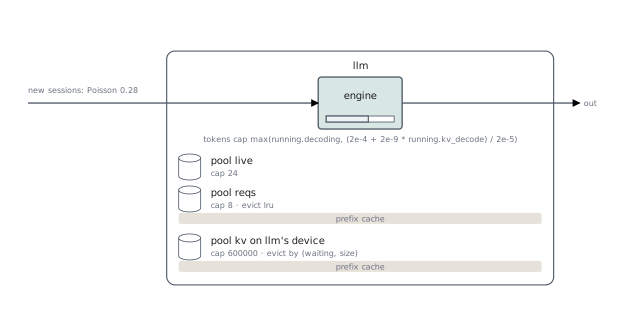
replica.sq's workload holds live for a session's whole conversation,
and its server holds reqs and kv only around the engine. A request is
served inside the workload's hold, so live is drawn too. All three are
held at llm alone, so all three are rows in its frame.
A program that holds nothing
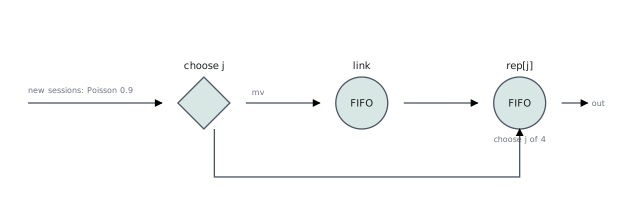
routing.sq has no pools at all. The figure therefore has no pool enclosures. The choose j of 4 under rep[j] is the routing policy.